Understanding PMMA Load & Deflection Design Guide is essential for anyone planning large acrylic aquariums, underwater tunnels, swimming pools, or architectural viewing structures. Proper load and deflection calculations ensure safety, long-term performance, and beautiful optical clarity.
This comprehensive PMMA Load & Deflection Design Guide explains the key engineering principles, real-world considerations, and practical recommendations based on Leyu Acrylic’s nearly 30 years of experience.
Why PMMA Load & Deflection Design Guide Matters
PMMA (polymethyl methacrylate), commonly known as acrylic, is widely used for its superior clarity and design flexibility. However, when building large structures, managing load and deflection becomes critical.
Excessive deflection can cause visual distortion, stress concentration, and even structural failure. A well-applied PMMA Load & Deflection Design Guide helps engineers select the right thickness, support system, and safety factors.
Key Factors in PMMA Load & Deflection Design
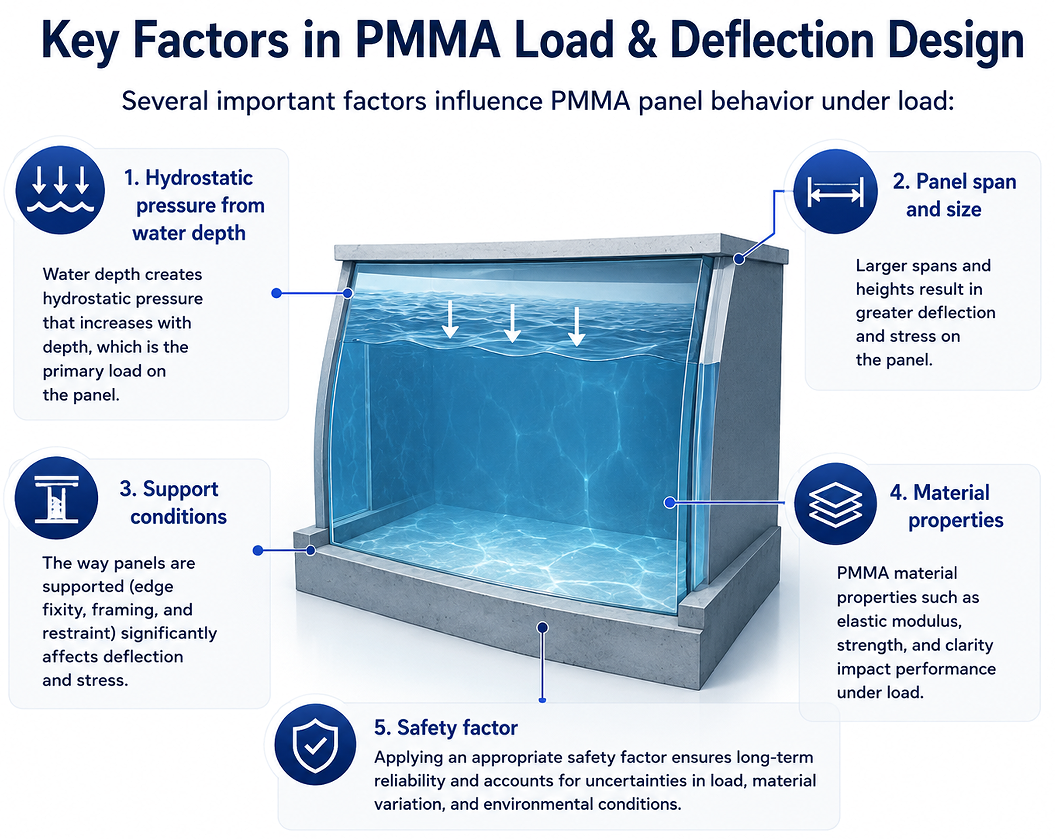
Several important factors influence PMMA panel behavior under load:
1. Hydrostatic pressure from water depth
2. Panel span and size
3. Support conditions
4. Material properties
5.Safety factor
Recommended Thickness Guidelines
PMMA Load & Deflection Design Guide – Thickness Recommendations
(For reference only. Final thickness must be verified by professional structural analysis.)
| Pool Type | Water Depth | Recommended Thickness | Typical Application |
| Residential Backyard Pools | ≤ 1.5 m | 40mm – 80mm | Standard home pools |
| Infinity Edge & Rooftop Pools | 1.5 – 2.5 m | 60mm – 120mm | Luxury residential & hotel pools |
| Commercial & Resort Pools | 2.0 – 3.0 m | 80mm – 200mm | Public and resort facilities |
| Deep Oceanarium Exhibits | > 3.0 m | 150mm – 400mm+ | Large viewing windows & tunnels |
| High-altitude Cantilevered Pools | Variable | 150mm – 250mm+ | Suspended & high-rise pools |
Real Project Examples
Leyu Acrylic has successfully applied these principles in numerous landmark projects:
| Project Name | Panel Type | Dimensions | Thickness | Key Feature |
| Shanghai Jumeirah Jinfengton Hotel | Infinity Pool | 28m long × 6m wide | 150mm | Elegant infinity edge with white curtains |
| Shenzhen OCT Xinxi Mingyuan | Suspended Infinity Pool | 57m long × 13.45m wide | 150mm | 270° sea view, 40m elevated |
| Shaoxing Jinchang Xianghu Langyue | Starry Infinity Pool | 24m curved wall | Marine-grade | 13,000 fiber optic lights |
| Fuzhou Kanuo Island | Infinity Constant Temp | 25m long × 8m wide | Suspended | 2.5m cantilevered transparent bottom |
| Changsha International New City | Sky Pool | 200㎡ visible area | 180mm | Direct view to ground below |
These real cases demonstrate how scientific PMMA Load & Deflection Design Guide calculations deliver safe, visually stunning, and structurally reliable results across different environments.
Above are selected representative cases.
Click to download for more details:  Company Profile & Core Products & Services.pdf
Engineering Best Practices in PMMA Load & Deflection Design Guide
A professional PMMA Load & Deflection Design Guide should include:
Detailed Finite Element Analysis (FEA)
Consideration of long-term creep behavior
Temperature and chemical exposure effects
Proper edge support and sealing systems
Regular inspection planning
Common Mistakes to Avoid
Underestimating deflection in large-span designs
Choosing insufficient thickness for deep water
Ignoring long-term creep and thermal expansion
Using inadequate safety factors
Conclusion
A well-executed PMMA Load & Deflection Design Guide is the foundation of safe, beautiful, and durable acrylic structures. Whether you are designing a luxury swimming pool, a grand aquarium, or a signature architectural feature, understanding load and deflection principles is essential.
Leyu Acrylic brings nearly 30 years of specialized experience, advanced manufacturing capabilities (30mm–800mm thickness, up to 10m×3m seamless), and proven project success to every PMMA Load & Deflection Design Guide consultation.
Contact Leyu Acrylic today. Our expert team will provide professional load and deflection analysis, thickness recommendations, and full technical support for your next PMMA project.
FAQ
1. Q: Why is thickness so important for acrylic panels in swimming pools and aquariums?
A: Thickness directly affects how much the panel bends (deflection) under water pressure. The right thickness keeps the panel safe, prevents visible distortion, and ensures long-term structural stability.
2. Q: How thick should an acrylic panel be for a typical home swimming pool?
A: For most residential pools with water depth under 2.5 meters, a thickness of 40mm to 80mm is commonly recommended. The exact thickness depends on panel size and support design.
3. Q: What thickness is suitable for infinity edge or rooftop pools?
A: Infinity edge and rooftop pools usually require 60mm to 120mm thick panels because they often have higher structural demands and less edge support.
4. Q: How thick do acrylic panels need to be for deep oceanarium exhibits?
A: For deep exhibits (over 3 meters), panels are typically 150mm to 400mm thick or more. Leyu Acrylic can produce up to 800mm thick panels for extreme requirements.
5. Q: What safety factor do you use when designing acrylic panels?
A: Professional designs usually apply a safety factor of 3 to 4 times the expected load. This accounts for long-term material behavior, temperature changes, and unexpected stresses.
6. Q: Can acrylic panels bend too much over time?
A: Yes, PMMA experiences creep (slow deformation) under constant load. That’s why proper thickness calculation and good support design are essential to control long-term deflection.
7. Q: Is thicker always better for acrylic swimming pool panels?
A: Not necessarily. Thicker panels are stronger but heavier and more expensive. The goal is to find the optimal thickness that balances safety, clarity, cost, and structural design.
8. Q: How do you calculate the right thickness for a large acrylic panel?
A: We use Finite Element Analysis (FEA) considering water depth, panel size, support conditions, and safety factors. Leyu Acrylic’s engineering team provides detailed calculations for every project.
9. Q: Are Leyu Acrylic panels strong enough for high-rise or cantilevered pools?
A: Yes. For high-altitude and cantilevered pools, we often recommend 150mm to 250mm thickness or more, combined with strong support systems, as proven in multiple successful projects.
10. Q: How long can properly designed acrylic panels last?
A: With correct thickness, good engineering, and regular maintenance, high-quality PMMA panels can maintain excellent performance and clarity for 20 to 30 years in swimming pool and aquarium applications.
 العربية
 Русский
 Español
 Português
 English
 Français
 Deutsch
 italiano
 한국어
한국어 Nederlands
 Tiếng Việt
 ไทย
ไทย Polski
 Türkçe
 አማርኛ
አማርኛ ភាសាខ្មែរ
 Bahasa Melayu
 தமிழ்
தமிழ் Filipino
 Bahasa Indonesia
 magyar
 Română
 Čeština
 Српски
 हिन्दी
 فارسی
فارسی Kiswahili
 Slovenčina
 Slovenščina
 Norsk
Norsk Svenska
 Ελληνικά
 Suomi
Suomi עברית
עברית Dansk
Dansk Shqip
Shqip বাংলা
বাংলা Hrvatski
 Afrikaans
 Māori
Māori සිංහල
සිංහල Беларуская мова
 Bosanski
 ދިވެހި
 Esperanto
 guarani
 Hausa
Hausa ʻŌlelo Hawaiʻi
 Kurdî
Kurdî Lietuvių
 Македонски
 ਪੰਜਾਬੀ
 Runasimi
 Türkmençe
 isiZulu